







Before ordering Pantone inks, specify the reference, substrate and planned finishing. A colour number does not define resistance requirements. Learn which information helps prepare and approve the right formulation.
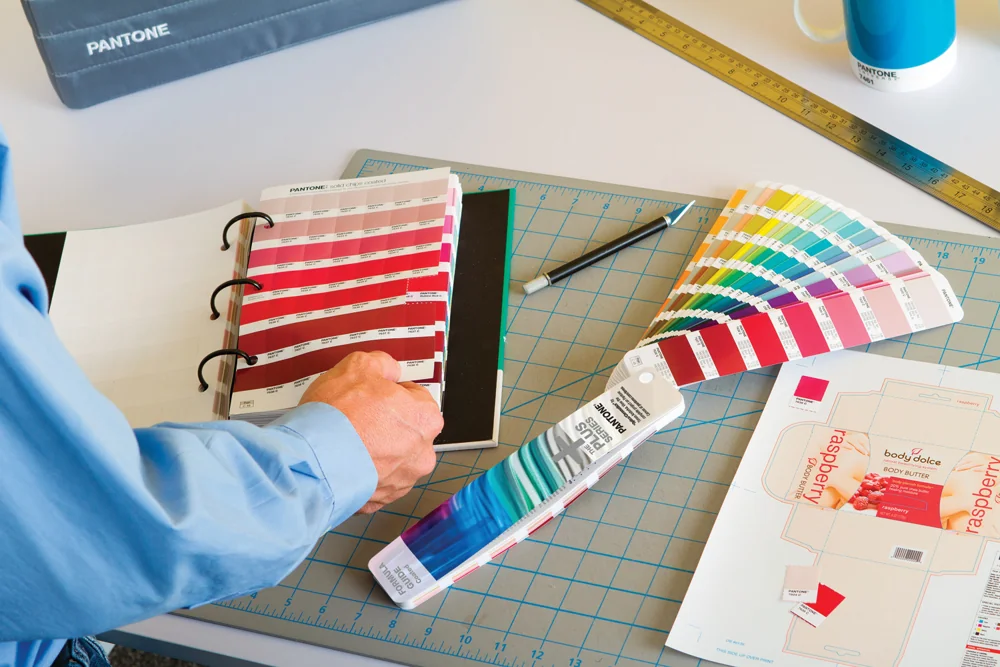
When to choose Pantone instead of CMYK?
Consider a secondary color when the design calls for a specific logo color or uniform color. Check with the client whether he will accept the reproduction of this color in four-color printing. Do not consider Pantone to CMYK conversion as a guarantee of identical color.
If you reproduce the color from CMYK, do not order a separate color without agreeing on the change of technology with the customer. An additional color may indicate a separate printing unit or another pass. Compare the cost of the entire job, not just the price of a kilogram of ink.
What do C and U mean next to the Pantone number?
The designation C shows the color appearance on coated paper and U shows the color appearance on uncoated paper. The same color may look different on both substrates. Provide the full designation and edition of the sample. This will give the mixing room a clear point of reference.
Choose a pattern that suits the material you are printing on. If the customer specified color C and the design goes on uncoated paper, clarify expectations before production.
What data should I provide to the ink mixer?
Prepare the data from the table below. Attach a substrate sample and an approved standard, if you have them.
| Information | What should I get? |
|---|---|
| Color | Pantone number marked C or U or your own sample. |
| Substrate | Type and weight of paper or cardboard; for the foil, also its type. |
| Technology, machine model and inking system used. | |
| Finishing | Planned varnishing, lamination and required resistances. |
| Order | Amount of ink, packaging and date needed. |
How to prepare and check the mixture?
Treat the recipe as a starting point. Formula Guide gives the proportion of ingredients, but the result also depends on the substrate and printing conditions. Match the mixture to the order and confirm the effect with a test.
If you mix inks yourself, use bases compatible with the selected ink system. Convert the recipe into batch size according to the supplier’s instructions. Do not arbitrarily replace mixing bases with process inks.
- Determine the target color and prepare the appropriate ingredients.
- Measure the ingredients and mix the batch thoroughly.
- Prepare a test on the target substrate and evaluate the result.
- After acceptance, record the recipe, medium and test conditions.
How much does mixing cost and how much to order?
W WIT offset ink mixing service you can order a batch from 1 kg. You can choose 1 kg or 2.5 kg cans and 5 kg or 10 kg buckets. We will determine the price and date after checking the color, quantity and required properties.
Need a standard variant? Check also ready-made Pantone inks. Compare availability and parameters with the ink prepared for a specific order. Paying extra for mixing makes sense when you need a specific color or property.
How to accept color before printing?
Compare the sample to an agreed standard on the target medium. Evaluate both materials under the same lighting conditions. Determine with the client the moment of assessment, the method of measurement and the person who will approve the result.
Don’t accept a color based solely on your screen or phone photo. Also check the condition of the sample: light, wear and aging of the paper affect its appearance.
What else should I ask before ordering?
Does the Pantone number guarantee light fastness?
No. The number identifies the color, and you must specify resistance requirements separately. Report light exposure, abrasion and chemical exposure during the quote.
Is any ink suitable for varnish or foil?
Don’t assume it. Specify the type of finishing and agree on the compatibility of the entire set of materials. In the case of food packaging, additionally determine migration requirements and necessary documentation.
Is a sample of an old print enough?
May help, but agree on whether it constitutes a binding standard. The old print may have changed color. Also provide a sample of the current subfloor and indicate which elements require compatibility.
For the quote, prepare the Pantone number, substrate, amount of ink and required resistances. Include information about varnishing or lamination.